
MOVE OR SCROLL TO ENTER
Can a fixed general-purpose VLM learn from demonstrations, examples, and interaction feedback and turn it into executable, verifiable behavior from a new initial state?

Overview
Enabling robots to adapt to unfamiliar environments as readily as humans remains a moonshot goal of embodied AI. No finite collection of demonstrations can cover every task and situation a robot will encounter, making the ability to learn from context at deployment essential for generalization. Such in-context learning (ICL), however, remains largely beyond the reach of existing robotic policies. The broad agentic capabilities of commercial vision-language models (VLMs), such as GPT-6 Astra, raise a compelling question: can these models learn from demonstrations, examples, and interaction feedback, then translate that information into executable and verifiable robot behavior from a new initial state without gradient updates or persistent changes to task-specific parameters?
We introduce GPT-Policy, a general-agent framework for in-context robot learning. GPT-Policy integrates a context compiler that preserves task-relevant visual transitions, a VLM that proposes robot-tool actions, and a constrained controller that verifies and executes each action and reports its outcome. We evaluate its reliability and limitations through task success and efficiency metrics, matched comparisons across models, and controlled context ablations. In real-robot trials, human video demonstrations improve task completion even without robot action labels, while aligned action references yield further gains on contact-sensitive tasks. These findings position GPT-Policy as a step toward robot adaptation through in-context learning, providing an empirical foundation for translating the general-purpose capabilities of VLMs into physical behavior and clarifying the challenges that must be overcome for reliable deployment.
How much robotic in-context learning is already accessible through general VLMs that were not trained as dedicated robot policies?
Context
Robotic ICL adapts behavior using demonstrations, examples, or interaction experience at test time, without gradient updates or persistent task-specific parameter changes. Each context family supplies information that the current instruction and observation may omit.
Procedure
01Ordered visual keyframes specify how a person carries out a task, without expert robot actions.
Fine contact
02Aligned visual evidence and optional action references support contact-rich manipulation.
Goal state
03A reference image gives the final arrangement and spatial relations without prescribing a sequence.
Memory
04Earlier observations, actions, failures, and outcomes remain available for exploration and recovery.
Coordination
05Pointing, turn history, and live feedback can change target selection and action timing online.
Method
GPT-Policy connects a general-purpose VLM to robot tools through a shared context-to-action interface. Embodiment-specific adapters translate tool requests into executable commands. Model parameters remain fixed; updated observations and execution or rejection feedback inform each subsequent decision.
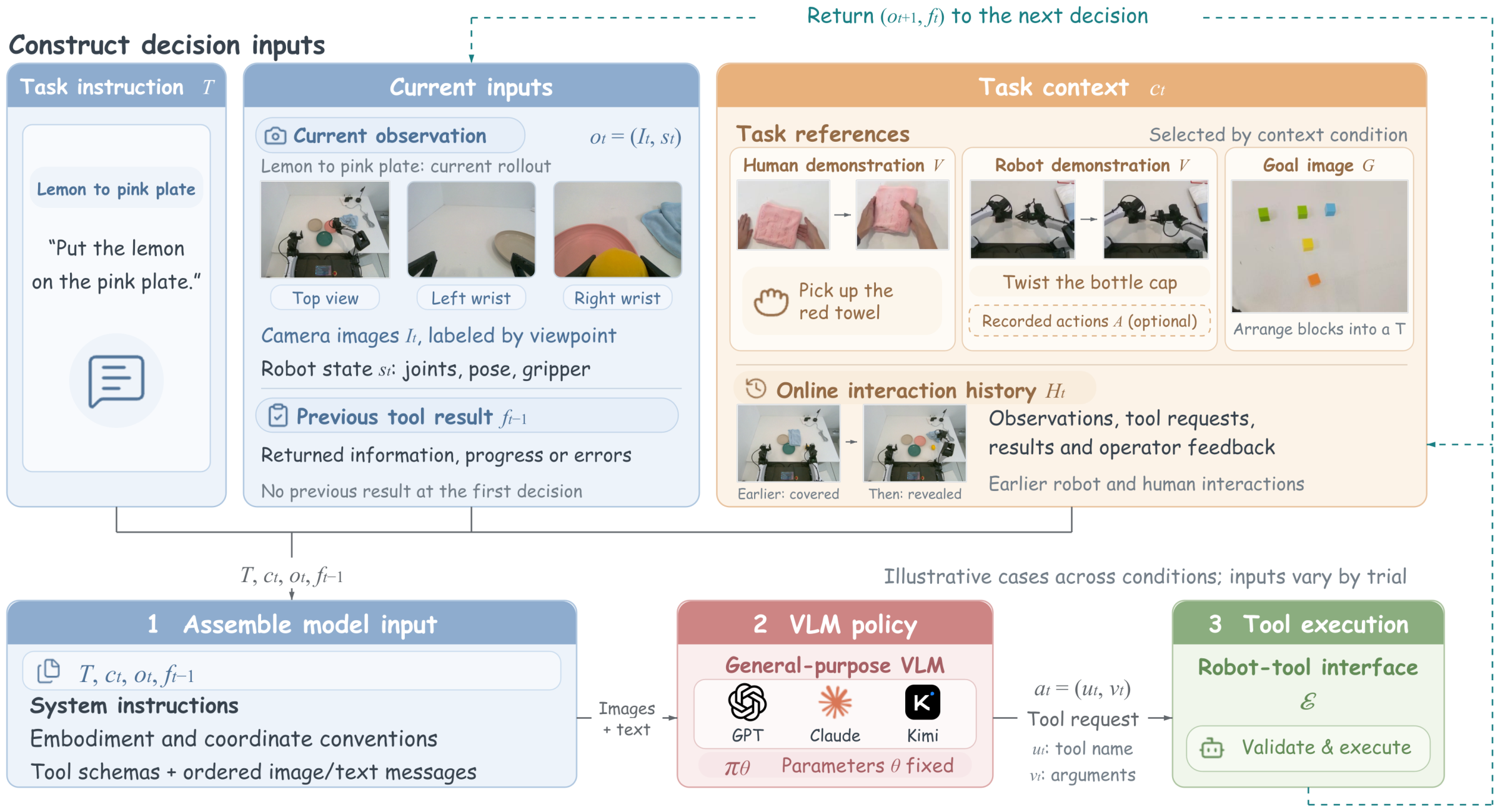
Combine task references, current views, state, and retained interaction history.
Interleave text and images with stable instructions, constraints, and tool schemas.
A fixed general VLM chooses one structured robot-tool request.
The Cartesian adapter samples poses, checks inverse-kinematics residuals, times joint references, and returns execution or rejection feedback.

Experiments
Human-video tasks compare runs with and without the human demonstration. Robot-demonstration tasks compare no video, video, and video + action. Other tasks show one representative run. Human demonstrations play at real time; robot runs are accelerated as labeled. Success rates and mean costs summarize all trials.
GPT-6 Astra on real robots; three trials per condition. Success requires the final scene to satisfy the task-specific geometric and semantic criteria. Decisions and time are averaged over all trials, including failures. Tic-Tac-Toe wins and draws both count as success.
Towel and notebook pickup test whether human demonstrations improve execution without robot action labels.
| Task | Context condition | Success | Decisions | Time (min) |
|---|---|---|---|---|
| Pick Red Towel | None | 0 / 3 | 96.3 | 24.6 |
| Pick Red Towel | Human video | 2 / 3 | 76.7 | 18.9 |
| Pick Up Notebook | None | 0 / 3 | 94.0 | 24.6 |
| Pick Up Notebook | Human video | 2 / 3 | 66.7 | 16.1 |
Bottle opening and plug reinsertion compare no demonstration, robot video, and robot video with aligned actions.
| Task | Context condition | Success | Decisions | Time (min) |
|---|---|---|---|---|
| Unscrew Bottle Cap | None | 0 / 3 | 71.0 | 16.1 |
| Unscrew Bottle Cap | Robot video | 2 / 3 | 74.3 | 15.2 |
| Unscrew Bottle Cap | Robot video + action | 3 / 3 | 54.7 | 17.9 |
| Remove and Reinsert Plug | None | 0 / 3 | 24.0 | 5.3 |
| Remove and Reinsert Plug | Robot video | 0 / 3 | 33.7 | 7.9 |
| Remove and Reinsert Plug | Robot video + action | 2 / 3 | 48.3 | 10.8 |
Block and fruit arrangement test whether the robot can reproduce a desired spatial configuration.
| Task | Context condition | Success | Decisions | Time (min) |
|---|---|---|---|---|
| Arrange T Shape | Target image | 3 / 3 | 66.7 | 15.8 |
| Arrange Fruit | Target image | 3 / 3 | 49.0 | 12.4 |
Lemon placement and mobile exploration test how earlier observations and failures support search and recovery.
| Task | Context condition | Success | Decisions | Time (min) |
|---|---|---|---|---|
| Lemon To Pink Plate | Self history | 3 / 3 | 35.3 | 8.1 |
| Movable Exploration | Self history | 3 / 3 | 40.33 | 25.53 |
Tic-tac-toe and pointed-fruit pickup test adaptation to human turns and gestures.
| Task | Context condition | Success | Decisions | Time (min) |
|---|---|---|---|---|
| Tic-Tac-Toe | Human-robot interaction | 3 / 3 | 69.7 | 13.6 |
| Pointed Fruit Pickup | Human-robot interaction | 3 / 3 | 67.3 | 15.0 |
What the current evidence shows
VLM Agents are surprisingly good at learning on the fly. Human videos reveal how a task unfolds, while action references provide more precise motion cues. In these early trials, such context helps Agents step outside their usual comfort zone and tackle fine manipulation and deformable-object handling.
Context can sharpen task understanding, planning, and adaptation. Still, knowing what to do is not the same as doing it reliably. Precise pose generation, contact execution, outcome verification, and physical safety remain challenges of their own.
VLM Agents can already generate useful actions, but each decision can still be slow and expensive. Specialized VLA/WAM models may therefore have an edge in fast, low-level control, while VLM Agents focus on reasoning, adaptation, and replanning.
Discussion
In individual red-towel runs, human video raises GPT-6 Astra task progress from 55% to 100%, with approximately 35.6% shorter run time and 58.9% lower estimated token usage. Fable 5.1 and Kimi K3 reach 30% and 20% progress. These examples do not establish a reliable model ranking: task progress is distinct from success rate, which is 2/3 for GPT-6 Astra with human video.
The evidence covers small task series under selected platforms, models, and context conditions. Incomplete ablations and unobserved pretraining limit causal and novel-skill claims. Context quality, observation–action alignment, execution latency, and human intervention remain constraints. Observed inter-arm collisions show that existing safeguards alone are insufficient for safe autonomous deployment.
@misc{cheng_incontext_robot_learning,
  title  = {In-Context Robot Learning with VLM Agents},
  author = {Cheng, Dongzhou and Yi, Taoran and Fang, Ye and
             Zhang, Xingwu and Feng, Fan and Li, Yixuan and
             Zhuang, Gengxiong and Wang, Rongze and Yang, Shuai and
             Song, Wei and Xue, Weizhi and Wu, Minyan and
             Gui, Jie and Wang, Jiaqi and Wu, Tong},
  url    = {https://cheng-haha.github.io/GPT-Policy/}
}